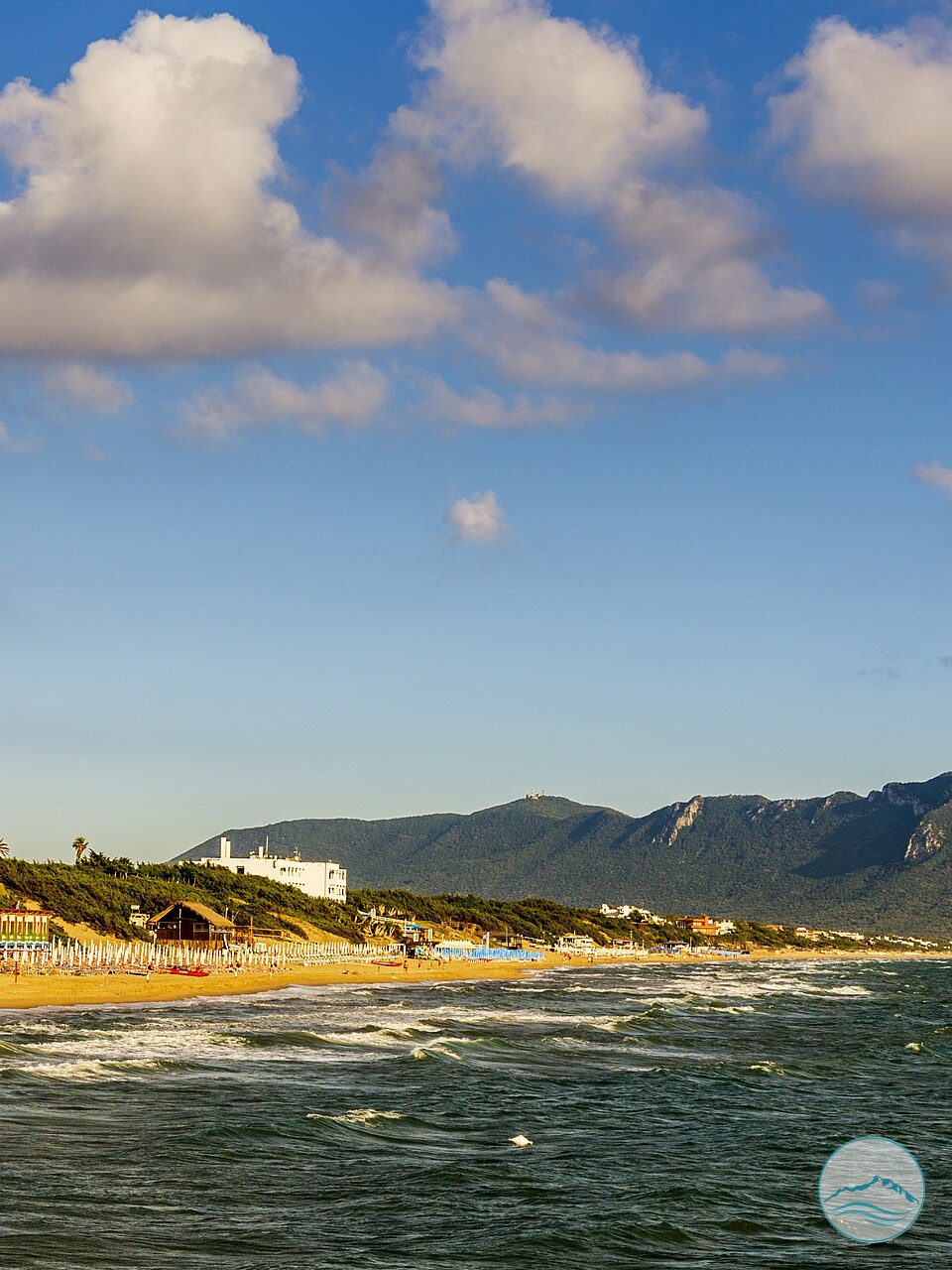
Site of Community Importance in the Natura 2000 network, established to protect the coastal and cliff habitats of the southern side of the Circeo promontory, known as the “Quarto Caldo”.
The Circeo promontory, whose highest peak reaches 541 m above sea level, was once an island; today it is joined to the mainland by the Pontine plain. Because of its particular exposure, it has always been notionally divided into four parts: the Quarto Freddo facing north, the Quarto Caldo facing south and the two temperate quarters in between. This exposure, so sharply divided by the points of the compass, creates a very distinctive difference in the plant and animal communities living in the different “Quarters”. The result is a remarkable biodiversity, recognised by the European Community too: on the promontory, in the Pontine plain, on the islands and in the sea around them and linking them to the coast, several Natura 2000 sites have been identified, as Sites of Community Importance (SCI, under the Habitats Directive 92/43/EEC) and Special Protection Areas (SPA, Birds Directive 79/409/EEC).
The “Quarto Caldo”, part of SCI IT6040016, covers about 428 hectares and stretches from the historic centre of San Felice Circeo to Torre Paola and from the sea to the ridge. Here the vegetation has adapted to the sun, scarce water and salt-laden sea winds. This is Mediterranean scrub, alternating with open areas of bare rock and purely grassy areas.
Let us take a virtual walk from the coast to the ridge. Where the sea reaches directly, the vegetation is halophytic (plants adapted to salty soils), such as the Circeo sea lavender (Limonium circaei), already mentioned by Pliny, and rock samphire (Crithmum maritimum), perhaps better known in Italy as Saint Peter’s herb, probably because it grows where fishermen go. Next comes a garrigue-like formation, made up mainly of shrubs and herbs such as rosemary, Mediterranean heath, rockrose and spurge. Climbing, we enter the low scrub of mastic, wild olive, phillyrea, Italian buckthorn, myrtle and holm oak in bush form, held together by rough bindweed (Smilax aspera). Higher still, the scrub also “rises”, with holm oak mixed with manna ash, wild olive, phillyrea, Phoenician juniper, various rockroses, mastic, terebinth, Italian buckthorn, strawberry tree and bay. Rosemary and Mauritanian grass manage to grow practically everywhere. The dwarf palm is typical here, taking root on the steepest parts of the rock face above the sea, today alongside agave and, in places, prickly pear. The dwarf palm (Chamaerops humilis) is native and grows wild, a reminder that temperatures were much higher in the distant past (it is considered a relic of the Tertiary), while agave and prickly pear were introduced by people.
The Quarto Caldo can be explored along the ancient road that has linked the town to the Lighthouse since ancient times, or along the parallel road a little higher up, aptly called Via del Sole (Sun Road), then continuing along Via delle Batterie. This ancient coastal road, described in the entry on the Capo Circeo Lighthouse, leads to Valle Caduta and Valle Moresca, where archaeological finds show human presence since prehistoric times.
The whole area was also inhabited by the Romans, as shown by remains of opus reticulatum walls near the Lighthouse and at Valle Caduta and by two water-collection cisterns. Another villa stood near Vasca Moresca, whose rectangular cistern gave its name to the whole area. Climbing towards the summit, you also come across remains of polygonal walls.
In the papal period the area was protected from attacks by Saracen pirates, among others, thanks to the watch kept by the towers. Today you can clearly see modern villas, a dry-stone wall known locally as the Galeazzi wall, and the well-known Punta Rossa residential complex.